
The Ungoverned
Enterprise
- Dave Rosenlund
Chapter 01
Which AI Rollout
Mishap Looks Familiar?
01 The enthusiastic
rollout
rollout
Three months later, security discovers that sensitive internal project details crossed a boundary the organization never defined. No breach. No regulator. But the next AI proposal dies in committee because nobody trusts the controls anymore. The cost was not a security incident. It was twelve months of stalled AI adoption across the entire organization.
02 The administrator's
dilemma
dilemma
An Atlassian administrator receives a one-line request from leadership: turn on Rovo for everyone. The admin knows the technical enablement steps. What nobody has defined is whether Rovo should summarize private HR documentation, surface information across project boundaries, or archive AI-generated insights as formal records. And if an AI-generated summary is wrong and someone acts on it, who owns the outcome?
Without answers, the administrator becomes the de facto risk owner for decisions that should sit with the executive team, legal, and compliance.
03 When AI automates
too much
too much
A service management team integrates AI into ticket triage. Resolution times improve.
Leadership is pleased.
Over time, edge cases accumulate. High-severity tickets get misclassified. Escalations are delayed because teams trust the AI assignment without checking it. When someone asks who approved the triage logic, who set the thresholds, and who is monitoring drift, nobody can answer. The cost is not a single incident. The cost is that the team can no longer explain its own operations.
Chapter 02
The Numbers Behind
the Problem
harmful AI incidents recorded in 2024. A 56% increase year over year. $67.4B in losses.
Chapter 03
Your AI Rollout Is
Already Behind on Governance
That is the moment governance either appears or disappears. In most organizations, it disappears. Not deliberately. It simply never gets raised. The enthusiasm is real, the executive mandate is clear, and governance feels like something that can be addressed later. Later rarely arrives.
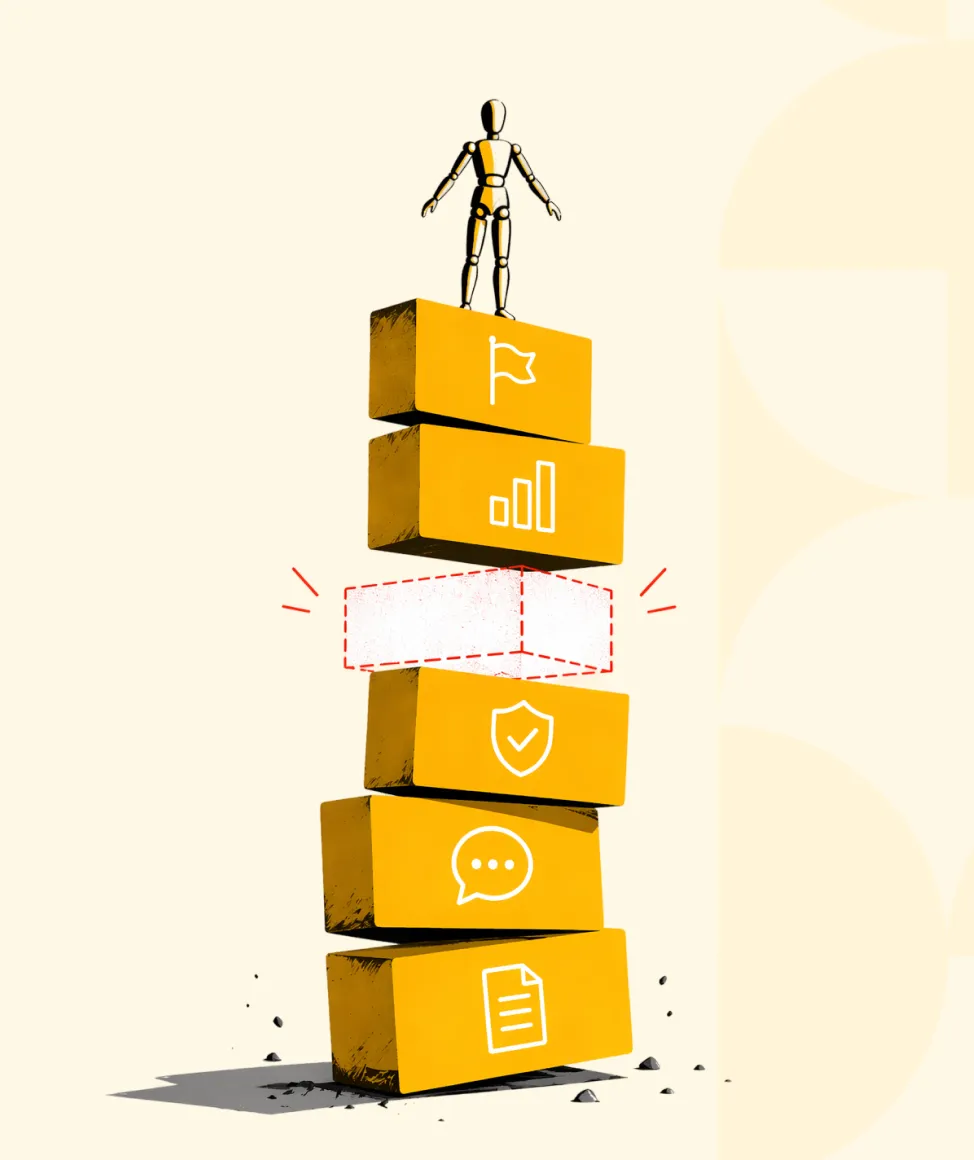
The NIST AI Risk Management Framework makes a point that is often cited but rarely acted on: governance is not a downstream activity. It is a continuous, cross-cutting function that shapes how AI systems are selected, integrated, and monitored throughout their lifecycle. In practical terms, governance means five things.
Defined accountability
Someone in the organization owns the decisions about where AI operates and where it does not. This is a named person, not a committee.
Clear usage boundaries
The organization has stated, in writing, what AI may and may not be used for. Not in a legal document. In a policy people can read.
Data access controls
The AI cannot surface, summarize, or act on information that the user would not otherwise be authorized to see. This requires reviewing the permission model, not just the AI settings.
Risk visibility
Leadership can see, at any point, what AI is doing inside the platform and where the exposure is. Not after an incident. Continuously.
Continuous oversight
The governance does not end at enablement. It evolves as the platform evolves. Each new AI capability is a new governance surface.
When AI becomes embedded in work management platforms, where issues, documentation, service tickets, and project decisions live, the stakes are fundamentally different from a personal productivity tool. These systems are not peripheral. They are institutional memory. Every ticket, every Confluence page, every Jira workflow represents a decision the organization may need to explain later.
Four words. One enormous governance gap.
Chapter 04
Turn On Rovo for Everyone
The request sounds simple. It is not. Rovo respects existing user permissions. If a user does not have access to a Confluence space or a Jira project, Rovo cannot see that content either. That is a meaningful baseline. But it is not a governance framework. It is a technical control. And technical controls on their own are not enough.
Consider the permission models that most enterprise Atlassian instances actually have. In our experience, they have grown organically over years. Permissions have accumulated. Spaces created for one team have been shared more broadly. Projects intended to be private have been opened up for convenience. The permission model reflects years of decisions made by dozens of administrators with varying levels of care.
In that environment, Rovo does not expose anything that was not already technically accessible. But it makes things findable that were previously hidden by obscurity. A user who technically had access to an HR Confluence space but never thought to look will now get summaries of that content surfaced in response to a natural language query. The information was accessible before. It was not discoverable. Rovo changes that.

In most organizations, nobody has answered these questions before the administrator is asked to flip the switch.
Governance exists to prevent operational teams from carrying unspoken strategic risk. When an organization invests in a clear AI usage policy before enabling capabilities, the administrator’s job becomes what it should be: technical implementation within defined boundaries.
Chapter 05
Your Policy Exists to Shape
Behavior, Not Satisfy Auditors
That approach misunderstands the role of policy. An effective AI usage policy does not exist to satisfy auditors. It exists to shape the behavior of the people who use AI every day.
The OECD AI Principles emphasize transparency, accountability, and human-centered oversight as core pillars of responsible AI systems. ISO/IEC 42001, the first international standard for AI management systems published in 2023, reinforces that AI must be governed within a management system that defines roles, responsibilities, and controls. These frameworks matter. Any serious governance effort should be aware of them. But the practical questions every organization must answer before scaling AI in a work management environment are not abstract.


That last question is more consequential than most organizations realize. When AI-assisted outputs influence formal work artifacts, those artifacts may become subject to regulatory review, audit, or legal discovery. Approvals, performance reviews, service responses, risk assessments, project decisions: if AI touched it, the organization must be able to explain how the output was generated, who reviewed it, and what safeguards were in place.
This is not a theoretical concern. The EU AI Act, which entered its
A useful AI usage policy should be readable in under fifteen minutes. It should be understood by executives, administrators, and end users alike. It should answer three questions plainly.
The frameworks were written for organizations building AI. Most Atlassian customers are consuming it.
Chapter 06
Where the Frameworks
Fall Short
This is the section that most governance whitepapers skip, and
it is the one that matters most if you are an Atlassian customer.
The major governance frameworks, NIST AI RMF, the OECD AI Principles, ISO/IEC 42001, are designed primarily for organizations building AI systems. They address model training, bias mitigation, algorithmic transparency, and the lifecycle management of AI as a technology product.
you govern…
you govern…
- The model and its training data
- The data that flows into the AI from your environment
- Bias in model outputs
- Permissions that determine what content the AI can access
- Algorithmic transparency
- Workflows the AI is allowed to influence or trigger
- Model lifecycle and version management
- Policies that define how your people use the AI
- Inference infrastructure
- Records management for AI-influenced work artifacts
- Training data provenance
- Response plan when AI outputs create harm or confusion
NIST published AI 600-1 in July 2024, a generative AI specific profile of the RMF, which gets closer to the consumer use case.
But even that document is oriented toward organizations with dedicated AI teams. Most Atlassian enterprise customers do not have a dedicated AI team. They have platform administrators, IT leaders, and users being asked to adopt AI capabilities already baked into the tools they use every day. The governance must meet them where they are.

Chapter 07
Policies Are Paper.
Guardrails Are Infrastructure.
The OWASP Top 10 for Large Language Model Applications, updated to its 2025 edition, identifies risk categories that most traditional IT security frameworks were not designed to catch. The table below maps the four most relevant risks to their practical implications inside a work management environment.
LLM01
Prompt injection


LLM01

LLM02
Sensitive information disclosure

LLM02
LLM06
Excessive agency

LLM06
LLM07
System prompt leakage

LLM07
CISA and a coalition of international security agencies released joint guidance in 2025 on securing AI data across its lifecycle.
Even when organizations are not training their own models, they remain responsible for how enterprise data is exposed during inference. The common assumption is that because the AI capability is vendor-provided and runs on a vendor-managed platform, the data risk belongs to the vendor. It does not. The vendor manages the model. The customer manages the data.
Guardrails are not expressions of distrust in AI. They are expressions of institutional maturity. The organizations that deploy them are not the ones that fear AI. They are the ones that intend to use it seriously and at scale.
Chapter 08
Not All AI Carries the
Same Risk
An employee using a general-purpose AI tool to refine an email draft carries limited organizational risk. The data exposure is narrow. The output is ephemeral. The consequences of a bad suggestion are minor and easily corrected.
An AI capability embedded directly into the system that governs work assignments, documentation, approvals, and service delivery carries a different order of consequence. It operates on institutional data. It influences decisions that become part of the organization’s formal record. It touches workflows that other systems, people, and processes depend on.
Here is a pattern we see regularly. An engineer cannot use ChatGPT to brainstorm solutions because the organization has banned all external AI tools. Meanwhile, Rovo has unrestricted access to every Confluence space in the instance, including spaces containing legal strategy, HR actions, and M&A planning, because nobody reviewed the permission model before enablement. The visible risk gets the policy. The structural risk gets overlooked.
Chapter 09
The Enthusiasm Comes from the Top.
The Risk Lands in the Middle.
Three groups. Three sets of priorities. One shared exposure.
focus on…
focus on…
The 78% shadow AI figure is not a failure of compliance. It is a failure of enablement. When the organization does not provide a governed alternative, people govern themselves. And when 38% of employees share confidential data with unapproved AI tools, the cause is usually not malice. It is that nobody told them clearly what they were and were not allowed to do.
Chapter 10
Governance Does Not
Have a Go-Live Date

Modern SaaS platforms update AI models and capabilities continuously. Features expand. Interfaces change. Underlying models may improve or behave differently. Atlassian has shipped significant changes to Rovo’s capabilities multiple times since its initial release, including expanded agent functionality, MCP server integrations, and enhanced search across connected third-party applications. Each update potentially changes the governance surface. A policy written for Rovo at launch may not adequately cover Rovo six months later.
Organizations must define who has authority to approve new AI capabilities as they become available, how model or feature updates are reviewed before broad enablement, what metrics indicate acceptable performance, and what thresholds trigger reassessment. Without these answers, each platform update becomes a governance event that nobody is managing.
Continuous oversight requires measurable signals: how often AI-assisted decisions require human correction, incident reports tied directly to AI outputs, exception patterns to the AI usage policy, and drift in classification or triage accuracy over time.
The EU AI Act compliance requirements for high-risk AI systems, which become fully enforceable in August 2026, make continuous governance a legal obligation for organizations operating in or serving European markets. But even without regulatory pressure, the commercial case is clear. Organizations that succeed with AI treat it as a capability requiring the same continuous attention as any other part of their operational infrastructure, not a project with a go-live date.
Without monitoring, governance becomes symbolic. Without authority, boundaries become suggestions.

Chapter 11
The AI Governance
Readiness Checklist
Organizations with complex regulatory environments, multiple Atlassian instances, or significant third-party integrations will need a more detailed assessment beyond this checklist.
brakes on AI. They are the steering system.
About Trundl

Trundl helps enterprises fast-track value from the platforms they work in. When an enterprise invests in Atlassian, monday.com, Microsoft, or Google, Trundl gets that investment delivering sooner and delivering in full.
Its patent-pending Rapid Deploy technology cuts deployment from months to weeks, and its engineered delivery method carries teams all the way to everyday use.
Founded in 2014, headquartered in San Jose, Trundl has run more than 300 enterprise deployments for customers including Toshiba, Medtronic, and Nutanix, serving leaders in healthcare, manufacturing, telecommunications, and financial services. Trundl is an Atlassian Platinum Solution Partner, monday.com Silver Partner, Microsoft Partner, and Google Partner, with ISO/IEC 27001 and SOC 2 Type II certifications and GDPR compliance.
If the scenarios in this paper sounded familiar, we should talk.

About Author
A four-year Atlassian Community Champion and advisor to Kantega SSO, Dave is passionate about helping enterprises deploy AI with confidence, accountability, and lasting business impact.

About the Author
References
1. NIST AI Risk Management Framework (AI RMF 1.0). National Institute of Standards and Technology, January 2023.
2. NIST AI 600-1: Generative Artificial Intelligence Profile. National Institute of Standards and Technology, July 2024.
3. OECD AI Principles (updated 2024). Organisation for Economic Co-operation and Development.
4. ISO/IEC 42001:2023. Artificial Intelligence Management Systems. International Organization for Standardization.
5. OWASP Top 10 for Large Language Model Applications, 2025 edition. Open Worldwide Application Security Project.
6. Best Practices for Securing AI Data. CISA, NSA, FBI, and international partners. May 2025.
7. The State of AI, 2024 Global Survey. McKinsey and Company.
8. Global AI Regulations Fuel Billion-Dollar Market for AI Governance Platforms. Gartner, February 2026.
9. Survey: Organizations with AI Governance Platforms Are 3.4x More Effective. Gartner, Q2 2025.
10. PEX Report 2025/2026: AI Governance Policy Adoption. Process Excellence Network.
11. Shadow AI in the Enterprise. WalkMe / SAP, 2025.
12. Stanford AI Index Report, 2025. Stanford University Human-Centered Artificial Intelligence.
13. EU AI Act. European Parliament and Council, 2024. Penalty phase effective August 2025.
14. Atlassian Trust Center and Rovo Data Privacy Guidelines. Atlassian, 2025.
15. 42% of AI Projects Fail in 2025. DZone, 2025.